The woman who sells peanuts at the corner of San Lázaro and Galiano has been there for as long as I have been walking that corner. I do not know her exact age. I would guess she is in her late sixties or early seventies. She wears the same blue apron she has worn every time I have seen her. She has a small folding stool. She has a tin can of peanuts and a small set of paper cones into which she measures them. She charges what she has charged for years, with the price adjusting at intervals to keep pace with the currency situation.
I have walked past her perhaps eight hundred times over the years. I have bought peanuts from her perhaps two hundred times. We have a relationship that consists almost entirely of the same six words repeated. "Buenas." "Buenas." "Un cucurucho." "Aquí tiene." "Gracias." "A usted." The exchange takes about thirty seconds. The relationship has been going on for fifteen years.
I want to write about her, partly because the relationship I have with her is one of the small ongoing relationships that has accumulated over my years of being in and out of Havana, and partly because the kind of relationship I have with her is, I think, one of the under-described categories of urban life that mattered more to my time on the island than the more cinematic relationships have.
What I know about her
I do not know her name. I have never asked. She has never offered. The transaction we have is brief enough and complete enough that the asking of names would alter the form of it in a way that I have, over the years, decided not to alter. The relationship is what it is. The name would change what it is.
I know she lives somewhere in Centro Habana, because I have, on a few occasions, seen her walking home in the late afternoon, in a direction that goes deeper into the neighborhood. I know she has at least two grandchildren, because she once mentioned them, briefly, on a day when a small child was hanging on her arm and helping her count the peanuts. I know she has a sister who lives in Havana del Este, because she mentioned her sister once when I asked about the heat one summer and she said she had spent the previous Sunday at her sister's and the breeze was different over there.
I know she walks to her corner every morning by approximately six-forty. I know she stays at the corner until early afternoon. I know she has a particular way of measuring the peanuts into the paper cone that involves a small shake at the end that I have always assumed is to settle the peanuts down to fit a few more in than the cone might suggest. I know her hands are the hands of someone who has done physical work for a long time.
I know her face well enough that I would recognize her, instantly, on any street in any city in the world. The recognition would be one-sided. She would not recognize me out of the context of her corner. The kind of recognition I have of her is not, I think, the kind she has of me.
What I have observed about her work
Her work is more demanding than it appears. She is on her feet, or on the small stool, for six or seven hours a day. The walking to and from the corner each day is, I estimate, about thirty minutes each way. She is at the corner in the rain and the heat. She is at the corner in the cooler months and in the months when the sun comes down on the corner at an angle that makes the corner one of the harder corners to be on in the afternoon.
She has, over the years, navigated multiple changes in the currency situation, in the licensing structure for street vendors, in the relationship between street vending and various authorities. She has, as far as I can tell, kept the work going through all of these changes. The work is, I assume, her primary income or a substantial portion of it. The work is also, I suspect, something more than just the income. The work is a daily structure. The work is a participation in the life of the corner. The work is the thing she has done every day for some uncountable number of years.
I have, on the few occasions when I have caught her between customers, exchanged slightly longer remarks with her. About the weather. About a particularly noisy taxi. About a procession that had passed through the corner the previous afternoon. The longer exchanges have been few enough that I remember each of them. The brevity of our usual exchange is, I think, mutual. Neither of us has tried to extend it. The form has held.
What the corner is
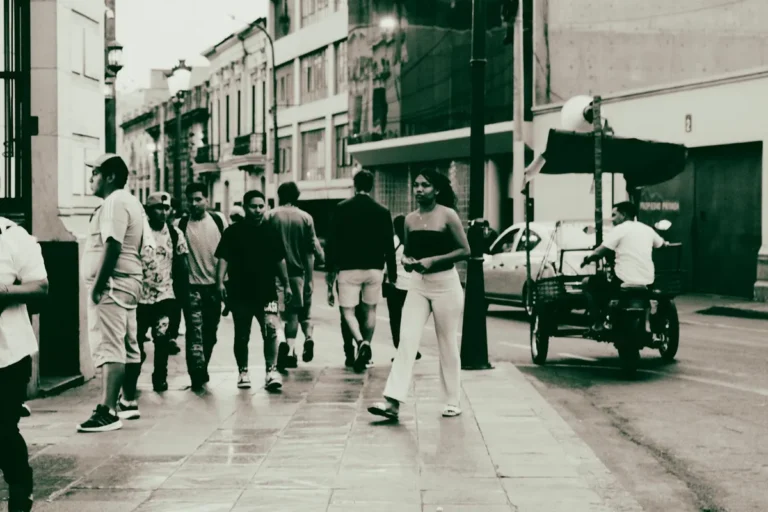
The corner of San Lázaro and Galiano is one of the corners that defines the texture of that part of Centro Habana. San Lázaro runs east-west, more or less, and connects the western edges of Centro to El Vedado. Galiano runs north-south, and is one of the principal commercial spines of Centro. The corner is busy in the way that good urban corners are busy, with traffic moving in multiple directions, pedestrians crossing in patterns that change through the day, and a constant flow of small commercial activity around the surrounding buildings. This busy corner, like so much of the city, offers notes on what's changed since my last visit.
The corner has, over the years, included other vendors besides the peanut woman. The man who sold cones of paper-wrapped popcorn for a while in the early 2010s. The woman who sold flowers from a bucket on Wednesdays through Fridays. The boy — he was a teenager then, he is now a man in his thirties — who sold packets of chewing gum and small batteries and razor blades.
The peanut woman has outlasted most of them. The flower seller stopped showing up around 2017. The popcorn man stopped earlier than that. The boy with the gum and the batteries grew up and moved on to other work. The peanut woman has continued. She is the constant of the corner. The other vendors who appear and disappear are the variables.
What buying the peanuts has been for me
I have thought, over the years, about why I have continued to buy peanuts from her even on days when I did not particularly want peanuts. The peanuts are fine. They are not extraordinary. There are days I buy a cucurucho and then leave the cone in my bag and find the peanuts a day later, mostly uneaten.
The buying is the thing. The buying is the small repeated ritual that has become, over the years, one of the ways I mark my presence in the neighborhood when I am there. The first day back on any visit, I walk by her corner. If she is there, I buy a cucurucho. The buying is how I tell myself that I am back. The buying is also, in some small way, how I participate in the corner — by being a continuing customer of one of the people who maintains the corner by working it.
I have tried, on a few occasions, to give her more than the price of the peanuts. To pay double. To buy two cucuruchos when I only want one. She has, on each occasion, gently refused or returned the difference. The transaction is what it is. The transaction does not accept the kind of one-sided largesse that I have, on a few occasions, tried to insert into it. The form holds, and the form is hers to set, and I have learned over the years to let the form be what it is.
What this kind of relationship is
The relationship I have with her is what I would call a recognition relationship. We recognize each other in the specific context of the corner. We do not know each other in any other sense. We have no other contact. We do not, as far as I know, have any common acquaintances. We exist in each other's lives as a face in a particular place at a particular hour. The recognition is the relationship.
I have had a number of these relationships in Havana. The man who sells the newspapers at the corner of Twenty-Third and L. The woman who runs the small cafetería that I sometimes get coffee from on my walk to Centro. The guard at the bank on Línea who has been there for, I think, eight or nine years now. None of these are friendships. All of them are real. They are the texture of how I move through the city. They are the people whose presence has accumulated, over the years, into something that makes the city feel like the city I know rather than a city I am visiting.
I have noticed, in Miami, that I have fewer of these relationships. The structure of urban life in Miami is different. I drive more. I walk less. The corners are not the same kind of corners. The people who staff the corners are, with a few exceptions, not the same people from one year to the next. The Miami version of these recognition relationships is thinner, and is one of the things I miss about the Havana version of daily life that I am sometimes hesitant to admit I miss because I do not want to sound like I am romanticizing a city that has, in many respects, made daily life more difficult than it needs to be.
What I want to say
The woman at the corner of San Lázaro and Galiano will, at some point, stop being there. She will retire, or she will move, or she will get sick, or one of the other things that ends the working life of a seventy-year-old woman who has been on her feet for fifty years will happen. I will walk to the corner one day and she will not be there, and I will assume she is having a bad day, and I will come back the following week and she will not be there, and I will, eventually, understand that the corner has lost her.
I do not know what I will do then. I will probably continue to walk the corner. I will probably look, for years afterward, at the spot where her stool used to be. I will, on some level that I will not be able to articulate to myself or to anyone else, miss her. The missing will be the missing of a person whose name I never asked and whose family I do not know and whose history is mostly invisible to me. The missing will be real anyway. The recognition relationship was a real relationship, even if its form was thin.
This piece is partly, I realize as I write it, an attempt to record the relationship while she is still there to be recorded. I will not show this piece to her. The form of what we have together does not include the showing of pieces like this. I am writing it for myself, and for whoever reads this site, and for the corner, in some abstract sense, that the corner deserves to have its people written about. She is one of the people of the corner. She has been one of them for longer than most of the things I now think of as defining my relationship to Havana. She matters to the city she lives in, in a way that the city she lives in does not always reward. I wanted to say so.